
I Was Told to Leave My Church, But I Never Left Jesus
I had been serving as the head of a worship ministry for five years when my pastor introduced a new requirement for those serving in leadership: Every member of the leadership team was expected to participate in an inner healing session.
In these sessions, the pastor, his wife, and an elder would sit with us and offer “inner healing.” No counselors. No licensed therapists. No psychiatrists. We were expected to share our wounds, struggles, past, and deeply personal experiences to remove emotional and spiritual roadblocks.
And it didn't sit right with me.
I didn’t trust that what I shared would be confidential.
I didn’t trust that I would receive sound advice.
I didn’t trust that what I shared wouldn’t be weaponized against me.
For months, I prayed. I searched the Scriptures. I sought counsel from licensed therapists and trusted mentors. Eventually, I met with my pastors and explained that I did not feel at peace about participating in the sessions. I made it clear that I was not questioning their motives or trying to create conflict, and if declining to participate in this inner healing meant I could no longer serve in leadership, I understood and was willing to step down.
I made it clear that I did not want to leave the church and explained that I was simply stepping down from a volunteer role within the church.
The matter was brought before the elder board, and their decision was not simply to remove me from leadership. They asked me to leave the church altogether. I was told to gather my belongings and not return.
A lifetime of service in ministry. Worship teams. Children's ministry. Women's ministry. Conferences. Drama teams. More Conferences. Directing Church pageants and productions . . . and this is how I was treated? This is how it ended.
The church was not merely a place I attended. It was a place where I had invested my time, energy, gifts, and love.
And suddenly, it was over, and what followed was grief.

When Everything You Believe Is Questioned
Like many Millennials, Gen Zers, and Gen Xers, I guess you can call me a “deconstructionist.” In recent years, the term deconstruction has become common in Christian circles. For some, it describes a complete rejection of Christianity. For others, a season of questioning inherited beliefs, examining long-held assumptions, and reevaluating the systems and traditions that shaped their faith.
My experience was much closer to the latter.
I began asking difficult questions. Why did I believe what I believed? Which convictions came from Scripture, and which came from family, culture, tradition, or human authority? What did the Bible actually teach, apart from the voices that had interpreted it for me?
Most importantly, I began asking:
What does Scripture actually say?
Deconstruction often draws criticism because some people ultimately walk away from Christianity altogether. While that certainly happens, it is not the only possible story.
It was not my story.
I was wounded by people.
I was disappointed by the leaders.
I was hurt by a church.
But I never left Jesus.
In fact, I discovered Him more deeply than I ever had before.

I Left a System, Not a Savior
When many of the structures I had relied on were stripped away, Christ remained.
In fact, He became my everything.
My Best Friend.
My Father.
My Comfortor.
My Counselor.
My Lord.
My King.
As I opened the Scriptures for myself, I encountered Him again and again within their pages. Not the Jesus of church politics. Not the Jesus of religious performance. Not the Jesus shaped by the expectations of others. The real Jesus.
He held my hand every Sunday morning as I worshipped in my living room with my three-year-old son. He guided me as I started a non-profit community theater. He counseled me through tears. He told me when to speak and when to keep silent. He healed me. He became my life.
When I actually opened the Word for myself, not through someone else's filter but out of a genuine desire to know Him, I found Jesus in a deeper way than I ever had before.
And everything changed.
Maybe You’re Not Done With Jesus Either
Friend, if this story feels familiar, I want you to know I am truly sorry. I am sorry for the ways institutions have wounded you, for the people who tried to break your spirit. I am sorry that your worth was ever doubted, that your voice was not heard, and that you felt alone. You are seen. You are valued. You are not forgotten.
Maybe, deep down, you are not done with Jesus.
Maybe you are still walking through the grief that comes when everything you once trusted is in question.
Maybe you are sorting through disappointment, confusion, anger, or loss, and it feels heavy.
Maybe you are wondering what is left when the systems you trusted begin to fall apart.
And maybe you are simply weary of the noise, the pressure to perform, the pretending. Maybe you are tired of the man-made systems that hurt you, and the people who did not reflect Jesus well.
I want you to know that you are not alone.
Many assume that questioning is the opposite of faith. Scripture suggests otherwise. The Psalms are filled with questions. Job asked questions. The prophets asked questions. Even the disciples struggled to understand what God was doing.
Questions do not necessarily indicate a lack of faith.
Sometimes, they are evidence that faith is seeking a firmer foundation.

Burned out on religion
Jesus offers an invitation to those of us trying to believe again.
An invitation that says . . . "Come to Me..."
“Are you tired? Worn out? Burned out on religion? Come to me. Get away with me, and you’ll recover your life. I’ll show you how to take a real rest. Walk with me and work with me—watch how I do it. Learn the unforced rhythms of grace. I won’t lay anything heavy or ill-fitting on you. Keep company with me, and you’ll learn to live freely and lightly.” - Matthew 11:28-30 MSG
Looking back, I realize I was never done with Jesus. I was exhausted by religious performance and weary of expectations. I was disillusioned by the gap between what some people preached and how they treated others.
But I was not done with Jesus.
What ultimately brought healing was not a dramatic moment or a quick solution. It was the slow and often painful work of abiding with Him. It was timein prayer, journaling, and honest conversations with trusted friends. Believing again looked like tears, daily walks with my son, sleep, nourishment, and learning to trust that this season wouldn’t last forever.
Most of all, it was the daily practice of returning to Scripture, Inscribing the Word, and learning who He was.
And that work takes TIME.
The work of the Holy Spirit is often slower than we would like. We live in a culture that prizes immediate results, yet healing rarely follows that timetable. More often, the Spirit’s work unfolds quietly, gradually, and almost imperceptibly until one day we realize we are no longer where we once were.
If you are in a place where you are deconstructing your faith, questioning everything, and wondering if anyone understands, you are welcome here, as are your questions and wonderings.
He Carries Your Tears
Today, carve out a few minutes and open your Bible to Psalm 56. Take out a notebook and write the words slowly, one verse at a time. Resist the urge to rush.
Simply sit with the text.
Listen.
Pray.
Allow the Spirit of God to meet you there.
You may discover, as I did, that what you thought was the end of your faith journey is actually the beginning of a deeper one.
Grace and Peace
ERIKA BAIN
A Companion for This Journey
If you’re looking for a quiet way to sit with Jesus again, I created a simple Lectio Divina Companion Notebook to walk with you. It gives you gentle prompts and space to listen. No performance, just time in His presence at your own pace.
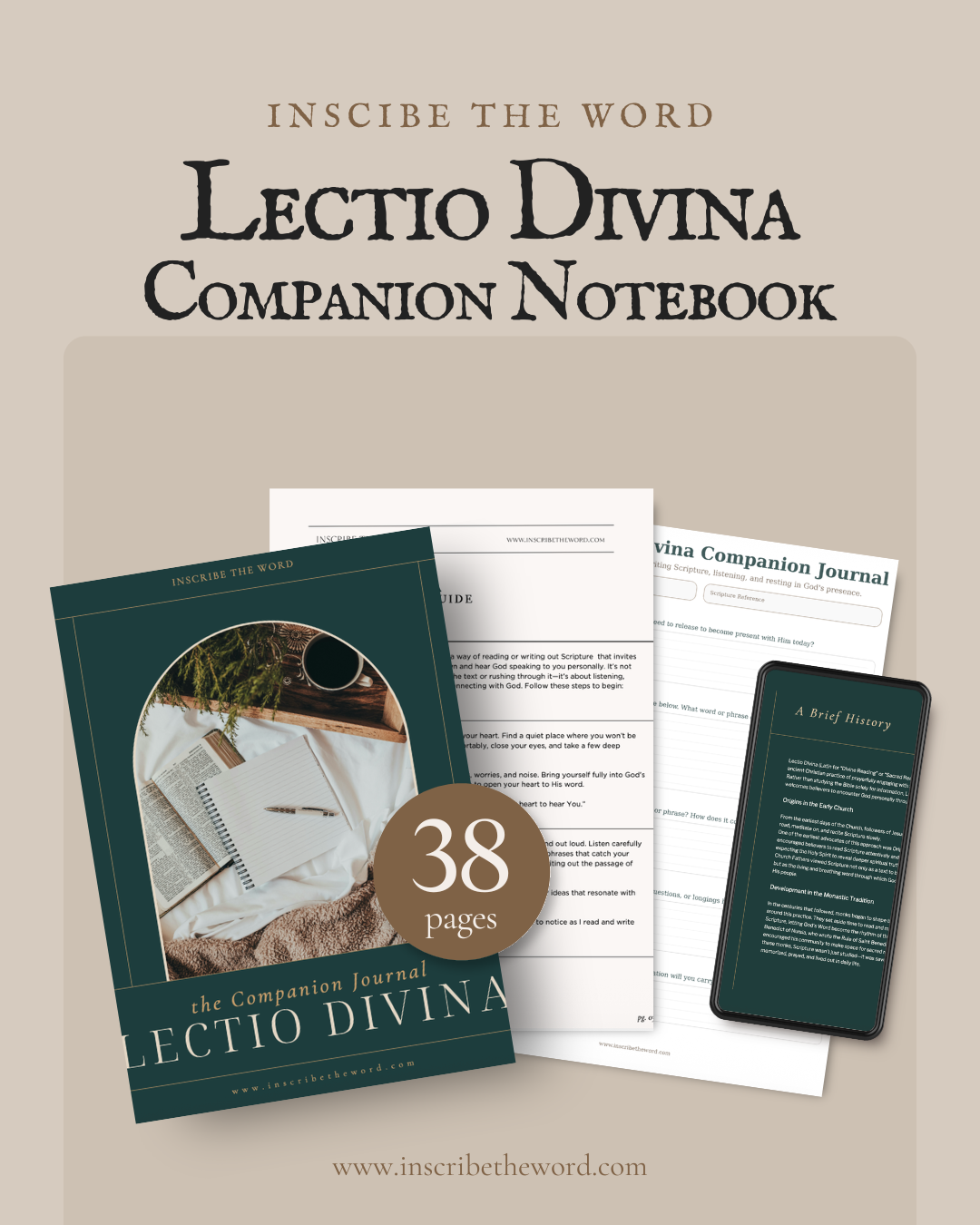
What this journey offers:
A Gentle Introduction to Lectio Divina that explains the history and heart of this ancient practice in clear, accessible language
Step-by-Step Guidance through the five movements of Lectio Divina—Silencio, Lectio, Meditatio, Oratio, and Contemplatio—so you always know what to do next
A 30-Day Printable Companion Journal you can use again and again with any Scripture passage in your notebook, journal, or tablet
Guided Prompts for Each Step to help you quiet your heart, notice what stands out, reflect, pray, and rest in God’s presence
A Bonus 30-Day Scripture Writing Plan on HOPE to give you an immediate, gentle starting place when you’re not sure where to begin
Available as an instant download, The Lectio Divina Companion Journal is a 38-page guide and journal created for those who want a slower, more contemplative way to engage Scripture without having to figure out a structure on their own.
You’ll learn what Lectio Divina is, where it comes from, and how Christians have used it through the centuries to encounter God in His Word. Then you’re given simple, repeatable prompts and spacious journal pages that lead you through each movement of the practice: quieting your heart, reading and writing Scripture, listening for what stands out, responding in prayer, and resting in God’s presence.
This journal is especially helpful in seasons when your usual Bible reading feels dry or overwhelming, when you long to hear God’s voice more clearly, or when you need a gentle, non-performance-based way to remain in Scripture. You can use it alongside any of your existing Scripture writing plans or with the included 31-day HOPE plan
There is no set pace and no expectation to do it “right.” You can print and reuse the companion pages as often as you’d like, letting this simple rhythm of reading, writing, listening, and resting become a quiet anchor in your life with God.
