Part One: The Locked Door in the Hallway
When I was in kindergarten, I had my very first sleepover.
Cara and Patrice were my absolute best friends at the time. My mom got us special snacks, and she even bought me a brand-new sleeping bag for the big weekend! Before we went to sleep, we made a plan: the second we woke up on Saturday morning, we were going to play Barbies.
The next morning, I woke up early and ran downstairs. My mom was starting a pancake breakfast for me and my friends. I told her that we were going to play Barbies until breakfast was ready. Excited, I ran back upstairs to get my friends.
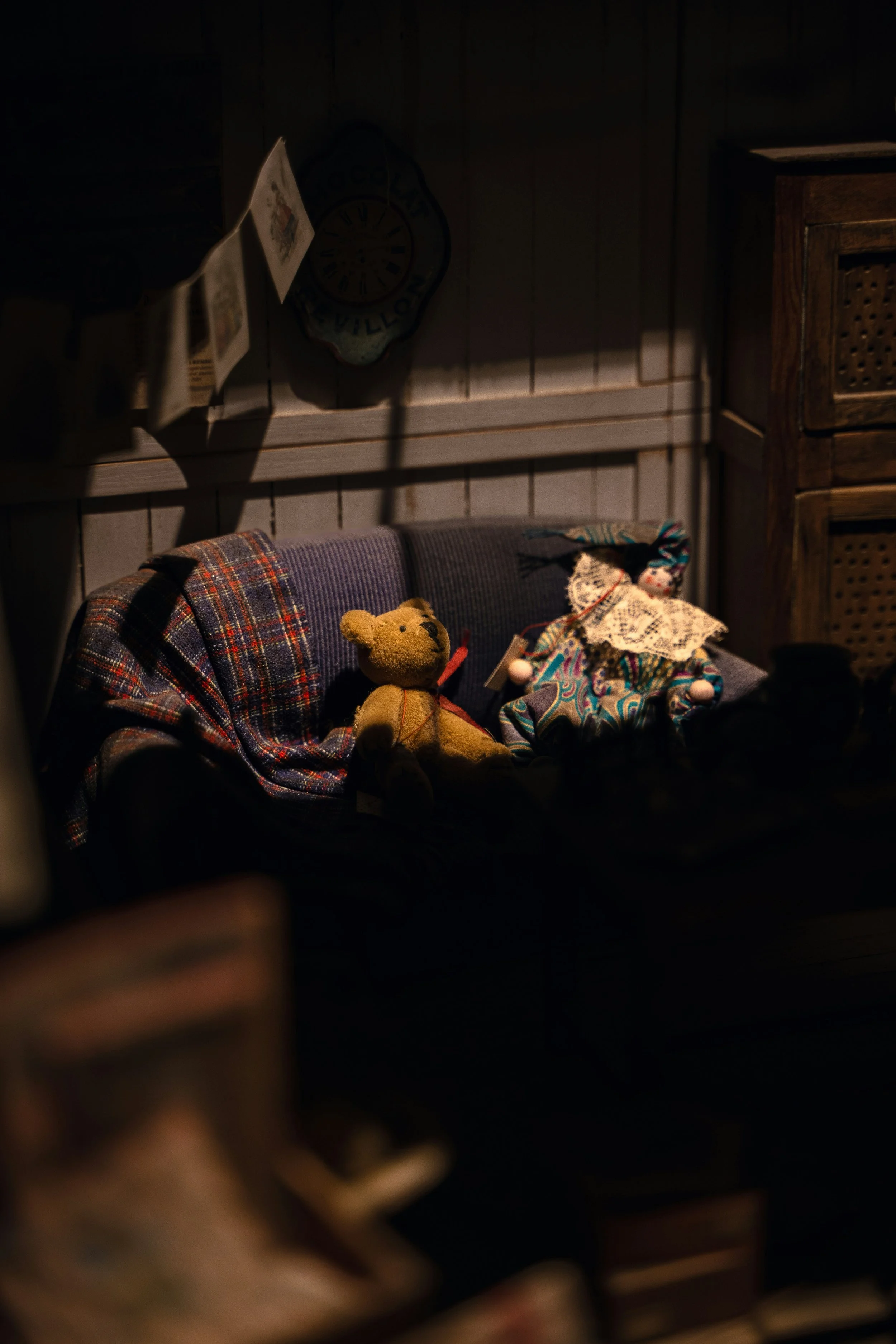
When I reached my bedroom, the door was closed and locked.
I knocked.
The door cracked open just an inch.
I smiled and said, "Are we playing Barbies? Let me in!"
They looked at me and said, "We’re playing Barbies by ourselves."
Then they shut the door in my face and re-locked it.
I remember standing in the hallway for a long moment, completely frozen, going through our conversations from that morning and the night before. What did I do wrong? Did I say something I shouldn’t have? Do they hate me?
Then I walked back downstairs and sat at the dining room table. My mom asked where my friends were, and I couldn’t tell her the truth. I didn't want to make a big deal out of it, and I didn't want to get them in trouble. So I just quietly said, "They're playing. I didn't want to play."
My “friends” eventually came downstairs and ate breakfast. They acted as if nothing happened and went home by noon.
That morning became a core memory. Looking back, I can see how a quiet narrative planted itself in my five-year-old heart: I am not one of the cool girls. I am not wanted. I am not fun. I am easy to lock outside the room.
The Propinquity Effect
I have carried loneliness throughout my life. While I am so grateful that my husband and son are my best friends, I have always longed for a female friendship that was reciprocated, deep, inspiring, and life-giving. Over my life, I have had many friendly acquaintances, but very few who stayed after the shared season ended.
We were close when I was teaching at the school.
We were friends when I was leading worship at the church.
We hung out while rehearsing the musical together.
But as soon as the project wrapped up or one of us moved on, the friendship evaporated.
Now, I watch my sixteen-year-old son facing the exact same painful cycle.
My husband, Steven, calls it "friendship by proximity."
Psychologists call it the Propinquity Effect, and sociologists call these Situational or Contextual Friendships.
The Propinquity Effect is the psychological tendency for people to form ties solely because of physical, spatial, or functional closeness.
Sociological research (notably studies by Dutch sociologist Gerald Mollenhorst) reveals that humans replace roughly 50% of their social network every seven years. When a relationship is built entirely on a shared setting, like a school, a team, a theater production, a church committee, or a workplace, it rarely survives the loss of that shared container unless both people consciously migrate it into a personal, vulnerable space. Without that intentional migration, the bond naturally dissolves.
In other words, you are friends as long as you are in each other’s daily space, working toward a common goal. But once that shared container ends, it becomes “out of sight, out of mind”.
For those of us longing for deep, lasting relationships, that transactional pattern hurts.
Friendships by proximity leave us visible, but unanchored. They make us useful for a season, but leave us unchosen for a lifetime. Deep inside every human heart is a neurobiological and spiritual longing not simply to be seen, but to be known.
We all just want someone to unlock the door, step aside, and invite us into the room.

The Loneliness Epidemic
If you have ever felt that ache of loneliness, you are not alone.
We live in a culture that is hyper-connected and still deeply isolated. We practice the art of friendship through screens and surface-level interactions while starving for true, safe, grounded connection. And when deep friendships or lifelong inner circles don't materialize the way culture says they should, we assume the fault lies entirely within us.
What feels like an isolated personal story is, in reality, a quiet public health crisis.
In 2023, U.S. Surgeon General Dr. Vivek Murthy issued a landmark advisory titled Our Epidemic of Loneliness and Isolation. The research revealed that chronic loneliness is not simply an emotional state. It is a physical distress signal. The mortality risk of severe social isolation is equivalent to smoking 15 cigarettes a day, exceeding the health risks associated with physical inactivity and obesity.
The data behind our social landscape shows why finding deep friendship in adulthood feels like climbing a mountain:
The Friendship Recession: According to the American Perspectives Survey, in 1990, 33% of Americans reported having ten or more close friends. By 2021, that number plunged to 13%. More strikingly, 12% of adults reported having no close friends at all. The number is now four times higher than it was in 1990.
The Erosion of Social Hours: Between 2003 and 2020, average in-person time spent with friends declined by 20 hours per month, while time spent in solitude increased dramatically.
The "200-Hour" Rule: Evolutionary psychologist Robin Dunbar and researchers at the University of Kansas discovered that it takes roughly 50 hours of shared time to move from an acquaintance to a casual friend, 90 hours to become a real friend, and more than 200 hours of intentional, un-tasked time together to form a close friendship.
In a world driven by individual efficiency, packed schedules, and digital interaction, almost no adult infrastructure exists to facilitate 200 hours of unhurried, non-proximity time. We are living in a society structured for isolation, while carrying nervous systems designed for deep community.

Search Me, O God
Yet, as heavy as these cultural changes are outwardly, honesty requires us to look inward as well.
Sometimes, what keeps us from deep friendships isn't just the world around us. It’s within us. We carry unresolved insecurities, build defensive walls, talk more than we listen, demand too much, guard our hearts, or become judgmental rather than curious.
True relational growth . . . true friendship . . . requires stepping into quiet self-examination before God.
In Psalm 139:23–24, David prays:
“Search me, God, and know my heart; test me and know my anxious thoughts.
See if there is any offensive way in me, and lead me in the way everlasting.”
It is a brave prayer that says: “Father, show me if there is anything in my heart pushing people away. Convict me when I am judgmental, critical, or distant. Open my eyes and correct me so that I can be a safer, better friend to those You send into my life.”
Over the years, seeking wise counsel, leaning into honest conversations with my husband, and spending time in therapy have helped me to see myself clearly. While I continually mess up, allowing God to refine me so I can show up well in the relationships He brings my way is always at the forefront of my mind.
Looking Ahead: The Lonely Places in Scripture
Understanding the science of loneliness and examining our own hearts frees us from the shame of thinking we caused our isolation, but it doesn’t take away the pain. True healing begins when we see how God meets His people in seasons of solitude.
In Part Two of The Loneliness Series, we will look closely at the lonely places in Scripture and see Paul in prison, David crying out from the darkness of a cave (Psalm 142), and Jesus withdrawing to solitary places to pray (Luke 5:16).
If you are standing in a room full of acquaintances, longing for a true friend, you are not broken. You are human. Your body, mind, and spirit are simply crying out for what God declared necessary from the very beginning of creation: It is not good for man to be alone. (Genesis 2:18)
Grace and Peace,
ERIKA